Cycling had the metrics. It never had the instrument. A racer's history holds a complete physiological identity, and nothing rendered it.
CASE STUDY 01: RACEPROOF
A racer's entire history, read back to them as a physiological identity.
Founded and built by one person.
That person also raced 2,041 times,
which is where the data came from.
That person also raced 2,041 times,
which is where the data came from.
01. PROBLEM
I asked this question for nine years.
The answer was in the data the whole time. Nobody had built the instrument to read it.
The answer was in the data the whole time. Nobody had built the instrument to read it.
02. APPROACH
I founded Raceproof to build that instrument: a data model and a visualization system that read a racer's full record and draws who the athlete is.
Design rule inherited from racing:
the raw numbers are always available. The instrument exists to make meaning, not decoration.
the raw numbers are always available. The instrument exists to make meaning, not decoration.
EXHIBIT: PRODUCT VISUALIZATION
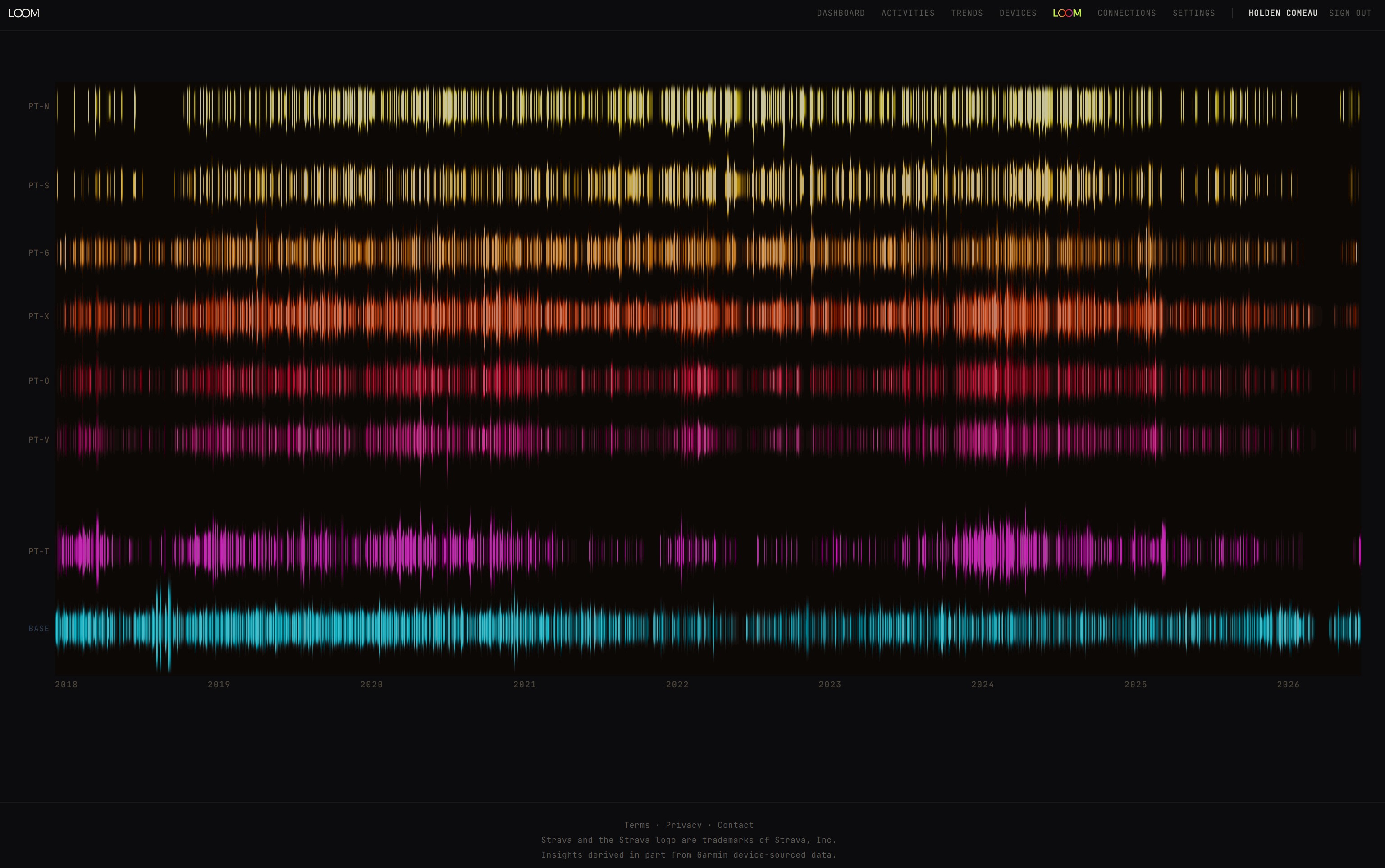
A: Each horizontal band is one physiological seat. Its color is fixed to that seat's identity.
B: Band brightness is expression: how fully the athlete expressed that seat's capability on that day.
C: Band height is that seat's share of the day's training stress.
D: The horizontal axis is the career: every day, rest days included, rendered as a continuous field.
The Loom. Raceproof's career visualization, current development build. One athlete's full record as a continuous field.
ROLE
Founder and designer
SCOPE
Product · data model · visualization system
STATUS
Live in beta
03. OUTCOME
Live in beta.
Beta metrics withheld on purpose.
Bring me a problem worth solving.
holden@halfwheel.io